
How many pallets fit in a 20ft or 40ft container?
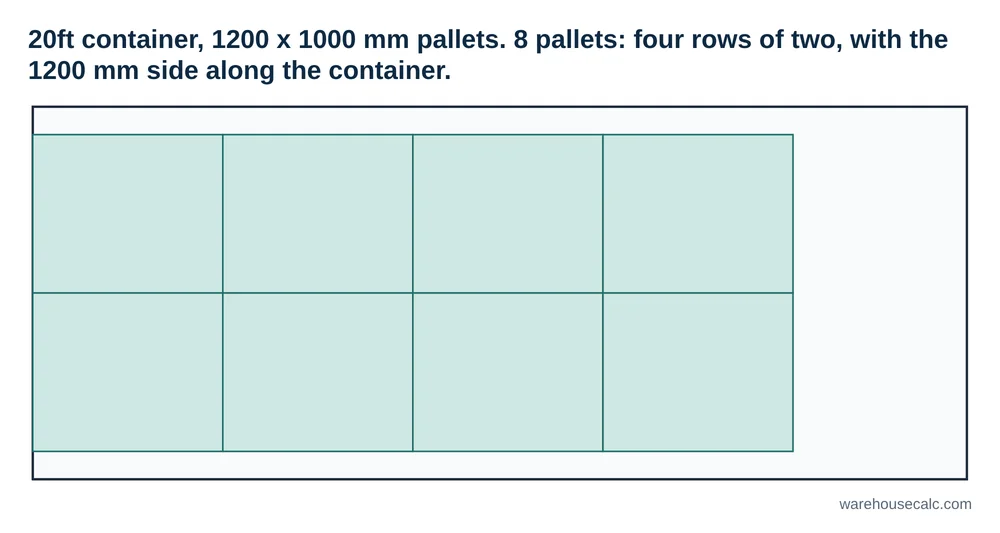
A 40ft container takes 20 pallets of 1200 × 1000 mm on one layer when they all face the same way, and up to 22 when some are turned. A 20ft container takes 8 pallets of the same 1200 × 1000 mm size facing one way, 9 in a two-lane turned layout and 10 in a four-block layout. This guide gives the counts for 1200 × 1000 mm, Euro (1200 × 800 mm) and US (48 × 40 in) pallets, shows where the higher numbers come from, and explains when weight decides before the floor is full.
Quick answer: pallets on one layer
These figures come from the Container Loading Calculator, for one layer of pallets on the container floor with no overhang. The first number is with every pallet facing the same way. The second is the best count found by the calculator’s Automatic layout, where some pallets are turned 90 degrees to use the leftover space. Each count applies only to the pallet dimensions in the column heading.
| Container | Standard 1200 × 1000 mm | Euro 1200 × 800 mm | US 48 × 40 in |
|---|---|---|---|
| 20ft Standard | 8 / up to 10 | 8 / up to 11 | 8 / up to 10 |
| 40ft Standard | 20 / up to 22 | 20 / up to 25 | 18 / up to 21 |
| 40ft High Cube | 20 / up to 22 | 20 / up to 25 | 18 / up to 21 |
Based on typical internal floor sizes of 5,898 × 2,352 mm for a 20ft container and 12,032 × 2,352 mm for a 40ft. Internal sizes vary slightly between shipping lines and container makers. The pallet footprints are listed in mm and inches in the standard pallet sizes guide.
Why there are two numbers
A container is about 2.35 m wide inside. Two 1200 × 1000 mm pallets fit side by side only when their 1000 mm sides are across the container (2,000 mm). Two 1200 mm sides do not fit (2,400 mm). So the straight layout is rows of two, with the 1200 mm side along the container.
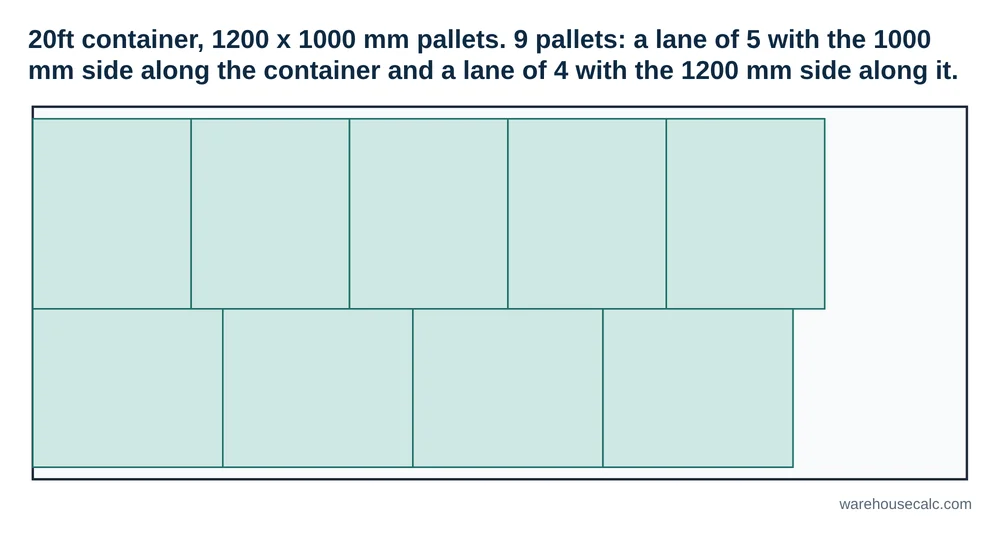
Most of the higher counts come from running two lanes with the pallets turned differently in each lane:
- 1200 × 1000 mm pallets in a 40ft: one lane of 12 pallets with the 1000 mm side along the container, and one lane of 10 pallets with the 1200 mm side along it. 12 + 10 = 22 pallets. Both lanes are 12,000 mm long in a 12,032 mm container, so only about 32 mm is spare.
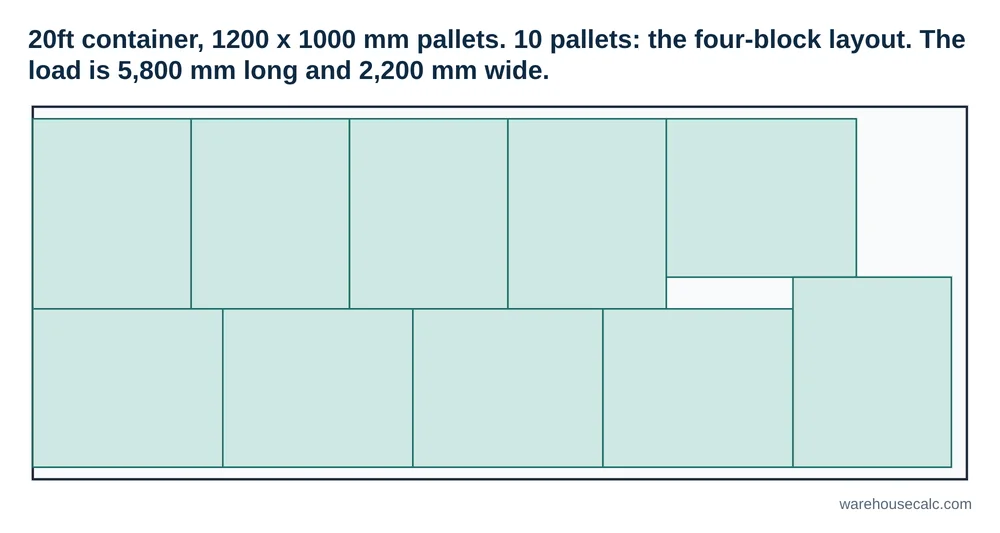
- 1200 × 1000 mm pallets in a 20ft: a lane of 5 and a lane of 4 = 9 pallets. The four-block layout shown below fits 10.
- Euro pallets in a 40ft: a lane of 15 with the 800 mm side along the container, and a lane of 10 with the 1200 mm side along it = 25 pallets, again with about 32 mm spare.
- Euro pallets in a 20ft: a lane of 7 and a lane of 4 = 11 pallets.
- US 48 × 40 in pallets in a 40ft: a lane of 11 and a lane of 9 = 20 pallets. A four-block layout fits 21.
The turned layouts leave almost no room to spare, and they only work if the forklift or pallet truck can pick the pallet up from the side you have turned it to. Treat the higher numbers as tight fits, not guarantees, and agree the layout with whoever loads the container.
The two-lane layout is not the only one. On a 20ft floor of 5,898 × 2,352 mm, 10 pallets of 1200 × 1000 mm fit in one layer in a four-block layout. One lane has four pallets with the 1000 mm side along the container, then one with the 1200 mm side along it. The other lane has four pallets with the 1200 mm side along the container, then one with the 1000 mm side along it. The load is 5,800 mm long and 2,200 mm wide, so about 98 mm of length is spare. Some published charts also quote 10 for a 20ft container. The Container Loading Calculator’s Automatic layout searches block layouts like this one as well as the one-way and two-lane layouts, so it shows 10 for this pallet size. The same search gives 10 for US 48 × 40 in pallets in a 20ft container and 21 in a 40ft, one more than the two-lane layout in each case. The table shows the best count found by the calculator. It is not a proof that no other layout fits more, so read it as the calculator’s figures and not as the highest count possible. If your pallets or container are a different size, check the layout for your own figures.
Top view of a 20ft container floor (5,898 × 2,352 mm) with 1200 × 1000 mm pallets, drawn to scale.
Does a 40ft High Cube hold more pallets?
Not on the floor. A High Cube has the same length and width as a standard 40ft container, so the count per layer is the same. The extra height (about 2,698 mm inside, against 2,393 mm) only helps if it lets you load taller pallets or stack a second layer.
Can pallets be double stacked in a container?
Only if the goods and the pallets can carry the weight on top, both layers fit under the roof, and the total stays within the container payload. Before any top clearance, two layers fit when each loaded pallet is no taller than about 1,196 mm in a standard container, or about 1,349 mm in a High Cube. The door opening is a little lower than the inside height, so allow for that as well.
Weight often decides first
Floor space is only half the answer. Typical payloads are about 28,200 kg for a 20ft container, 26,500 kg for a 40ft and 26,300 kg for a 40ft High Cube. They vary by container, and road weight limits at either end of the journey can be lower than the container payload.
Example: 22 pallets of 1200 × 1000 mm at 1,250 kg each is 27,500 kg. That is over a 26,500 kg payload even though the floor has room, so the load has to drop to 21 pallets (26,250 kg).
Heavy goods such as drinks, canned food, tiles or chemicals usually reach the weight limit before the floor is full. Light, bulky goods fill the space first.
How many CBM is a container?
A 20ft container has about 33.2 m³ of internal volume, a 40ft about 67.7 m³ and a 40ft High Cube about 76.4 m³. Pallets never use all of it, because of the pallet itself, the gaps between pallets and the space above the load. For loose cartons and mixed shipments, the CBM Calculator works out the total CBM and checks how many cartons fit. The guide What is CBM in shipping? explains the formula.
Common mistakes
- Using the outside size of the container instead of the internal floor size.
- Forgetting cargo overhang: 50 mm on each side turns a 1200 × 1000 mm pallet into 1300 × 1100 mm. A 40ft container then takes 9 rows of two instead of 10, and the two-lane turned layout no longer fits across the width (2,400 mm).
- Planning a turned layout with pallets that can only be lifted from two sides.
- Counting floor positions but not checking the weight per pallet against the payload.
- Assuming a refrigerated (reefer) container has the same inside width. The insulation makes it narrower, so check the internal size on your booking.
Written and checked by a warehouse supervisor with about 15 years of hands-on experience. Last updated: October 2026. All guides