
Pallet Calculator: Cartons per Pallet
Work out how many cartons fit on a pallet and the pallet configuration that fits the most. Enter the pallet size, the maximum loaded height and the carton size, and see the cartons per layer, the number of layers, the total height and weight, and whether space, height or weight decides the result.
Your pallet and cartons
Result
What limits the pallet
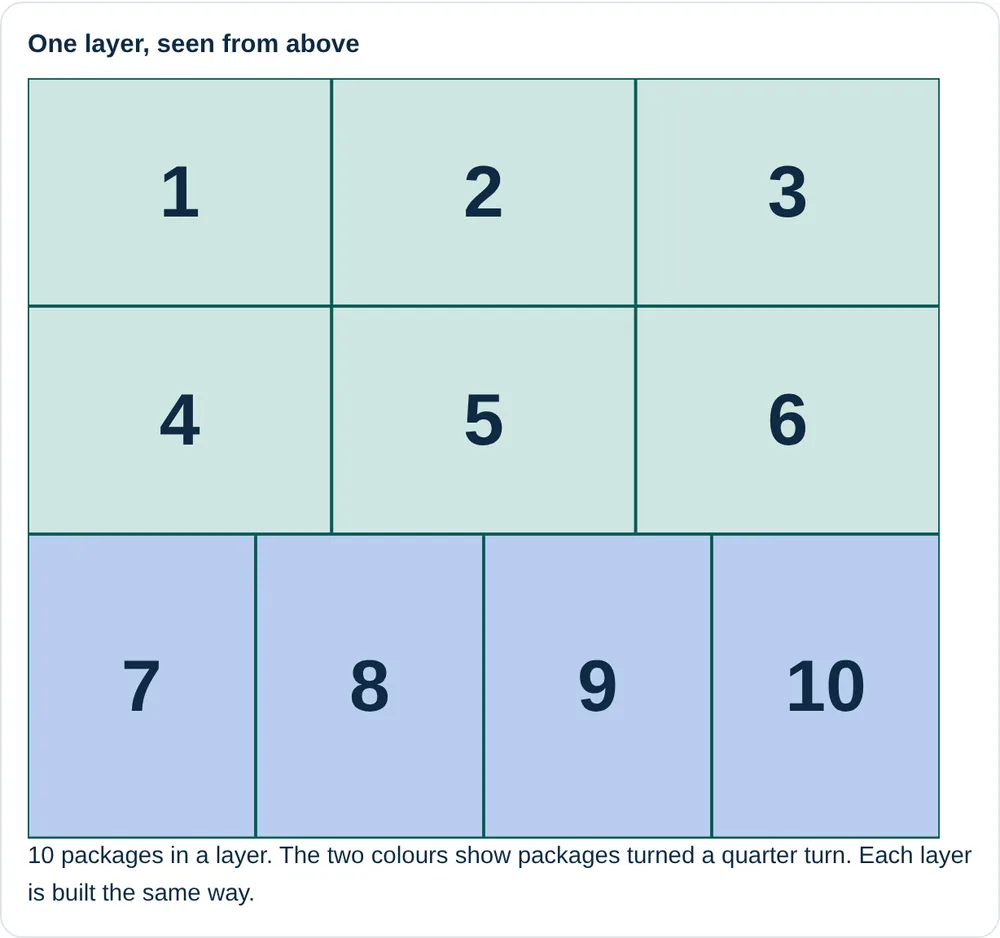
One layer, seen from above
The loaded pallet in 3D
How this was calculated
Printed from warehousecalc.com. Results are planning estimates; confirm them before you rely on them.
How many cartons fit on a pallet?
It depends on three limits, and the lowest one wins: how many cartons fit side by side on the pallet (geometric capacity), how many layers fit under the maximum loaded height (height-limited capacity), and how many cartons the weight limit allows (weight-limited capacity). The calculator shows all three, so you can see which one is holding the pallet back.
The weight limit and the maximum layers are optional. Leave them blank to see what space and height allow.
How to calculate cartons per pallet
- Cartons per layer. Fit the carton footprint (length × width) into the pallet area. This is a packing problem, not a division of volumes: a layer is built from rows, and blocks of cartons are turned a quarter turn where that fits more cartons into the leftover space.
- Layers. Take the maximum loaded height, subtract the height of the empty pallet, and divide by the carton height. Round down: a part layer does not fit.
- Cartons per pallet. Cartons per layer × layers, then reduced if the weight limit or the maximum number of layers allows fewer.
Dividing the pallet volume by the carton volume gives an upper limit, not a loading plan. It is usually too high, because it ignores the gaps left at the edges and under the height limit. The calculator does not use it.
Ti-Hi: cases per layer and layers high
In many warehouses, and on most supplier spec sheets in the US, a pallet pattern is written as a Ti-Hi. The Ti (tier) is the number of cases in one layer. The Hi is the number of layers stacked on the pallet. Ti × Hi gives the cases per pallet.
This calculator works out both: cartons per layer is the Ti and layers is the Hi. In the first example below, 10 cases per layer and 6 layers is a Ti-Hi of 10 × 6 = 60 cases per pallet.
A supplier’s Ti-Hi is worth checking before you rely on it. It may have been set for a different pallet size, a lower height limit (for example the clear height of your racking) or a weight limit. Enter your own pallet, height and weight limits to see the Ti-Hi that fits your operation.

What affects pallet capacity?
- Pallet size. A 1200 × 1000 mm pallet, a 1200 × 800 mm Euro pallet and a 48 × 40 in US pallet take different carton counts from the same carton. See standard pallet sizes for the common dimensions.
- Carton footprint. A few millimetres can change a layer. A carton that is 1 cm too wide for three across loses a whole column.
- Maximum loaded height. It is measured from the floor and includes the pallet. Carriers, trailers and racking each set their own limit.
- Weight. Heavy cartons often reach the weight limit before the pallet is full.
- No overhang. The calculator keeps cartons inside the pallet. If your load is allowed to overhang, check the rules of your carrier and your racking first.
Pallet loading examples
| Pallet | Carton (L × W × H) | Per layer | Layers | Cartons |
|---|---|---|---|---|
| 1200 × 1000 mm, 15 cm high, 180 cm limit | 40 × 30 × 25 cm | 10 | 6 | 60 |
| 1200 × 800 mm Euro, 15 cm high, 180 cm limit | 40 × 30 × 25 cm | 8 | 6 | 48 |
| 1200 × 1000 mm, 15 cm high, 100 cm limit | 40 × 30 × 25 cm | 10 | 3 | 30 |
| 1200 × 1000 mm, 15 cm high, 180 cm limit, 350 kg load limit | 40 × 30 × 25 cm, 10 kg | 10 | 4 (last one part full) | 35 |
In the Euro pallet example the 30 cm side of the carton runs along the 120 cm side of the pallet: four cartons across, two deep. In the last example space and height would allow 60 cartons, but 350 kg ÷ 10 kg allows only 35, so weight decides.
Carton orientation and stacking
Keep upright keeps the carton height vertical. Cartons are only turned around on the pallet. Use it for cartons marked “this way up”, or goods that must not be laid on their side.
Any side also tests standing the carton on each of its other sides, and uses the position that fits the most cartons. All layers use the same position. Choose it only if the goods allow it. If Keep upright is selected and laying the cartons on a side would fit more, the calculator tells you.
Use Maximum layers when cartons cannot be stacked as high as the height limit allows, for example because the bottom cartons are weak.
Pallet weight limits
Enter the weight of one carton and the weight limit of the load. The limit is for the cartons only, so deduct the weight of the empty pallet yourself. If one carton is heavier than the limit, the calculator says so instead of showing a zero. When the weight limit reduces the result, the calculator shows how many cartons would have fitted without it.
The weight limit is a planning figure that you supply. It does not check the load rating of the pallet, the racking or the vehicle.
Limits of this estimate
Each layer is packed with rows, blocks and one pinwheel arrangement. In rare cases a hand-built layer can fit one carton more. The estimate assumes straight columns, a flat pallet, no overhang, and cartons that carry the load above them. It does not check stability, wrapping or crushing. Confirm the final load with your carrier or warehouse.
Results are planning estimates. See the methodology for how the tools work and their limits.